LabVIEW implementation contributor within Brian’s NASA Ames software-engineering role.
Scientific computing / applied mathematics
Quasi-1D Thermophysics Modeling
Arc-jet calorimetry translated into software.
Translation of a published NASA conical-frustum inverse heat-conduction model into a LabVIEW implementation for geometry-aware arc-jet calorimeter analysis.
Published NASA method · Software translation · Public role context
Quasi-1Dconical-frustum thermal domainA–Dtridiagonal-system coefficient formulationLabVIEWexisting calculation environmentPublishedDriver et al. method implemented
A geometry-aware translation of the published quasi-1D inverse model into the acquisition workflow.
Produced a path for evaluating geometry-aware curved-body conduction within the acquisition environment.
A public-safe method diagram, the underlying NASA publication and Brian’s public role record.
01 / The difficult question
From published inverse analysis to usable acquisition software.
Heat flux in NASA Ames arc-jet testing can be inferred from a calorimeter’s temperature history using a conventional one-dimensional finite-slab inverse analysis. That approximation treats heat conduction as planar, but curved calorimeter bodies introduce geometric and lateral-conduction effects that can bias the inferred heating.
Published NASA research by Driver, Philippidis and Terrazas-Salinas investigated this problem and showed that the curved-body effect could instead be represented with a quasi-1D conical-frustum formulation. Their analysis treats a radial slice of the spherical body as a tapered thermal domain whose changing cross-sectional area is incorporated into the inverse heat-conduction calculation.
02 / Brian's contribution
Translate the mathematics into the LabVIEW workflow.
Brian studied the Driver et al. formulation and translated the published mathematical treatment into an implementation suitable for the existing LabVIEW calculation environment.
He worked through the spherical-coordinate heat equation, its numerical discretization and the geometric terms introduced by the changing radii of adjacent elements. The resulting formulation produces the A, B, C and D coefficients of a tridiagonal numerical system, which is solved at successive time steps as part of the inverse calculation.
He documented how the changing radius and area ratios convert the curved-body conduction problem into a computationally inexpensive quasi-1D representation rather than requiring a full multidimensional calculation. The supporting analysis worked through the coefficient definitions, numerical matrix formulation, thermal boundary conditions and implementation choices needed to map the published model into software.
He integrated the formulation into LabVIEW for evaluation within the arc-jet data-acquisition and heat-flux calculation workflow.
03 / How the system works
01Interpret
Work from the published spherical-coordinate heat equation and boundary conditions.
→02Discretize
Represent changing radii and area ratios across adjacent thermal elements.
→03Solve
Form the A, B, C and D coefficients of a tridiagonal system at successive time steps.
→04Integrate
Map the quasi-1D inverse calculation into the LabVIEW workflow.
The quasi-1D representation follows Driver et al.; Brian’s contribution was the research-to-software translation and LabVIEW implementation.
04 / Geometry-aware calculation
Carry the changing cross-sectional area into the numerical system.
A radial slice of the spherical body is treated as a tapered sequence of thermal elements. The radius and area ratios modify the neighboring-element coefficients while preserving an inexpensive tridiagonal solve.
This provides a practical middle ground between a planar finite-slab approximation and a full multidimensional calculation in the existing heat-flux workflow.
Published formulation
Map tapered geometry into neighboring-element coefficients.
ri−1riri+1area ratios → A · B · C · Dsuccessive time-step solve
Geometry-aware LabVIEW implementation
The work produced a LabVIEW implementation of the published geometry-aware inverse-analysis method, providing the acquisition environment with a path for evaluating curved-body heat conduction rather than relying solely on the planar finite-slab approximation.
Published context
The underlying Driver et al. research found that conventional finite-slab analysis could produce heating errors on the order of 10–15% for some calorimeter geometries, while geometry-aware conical formulations substantially reduced the spherical-body contribution to that error.
Published-method reconstruction
The geometry carried into the solve.
Each image is paired with the scope and context needed to interpret it. Open an image to inspect the full-size view.
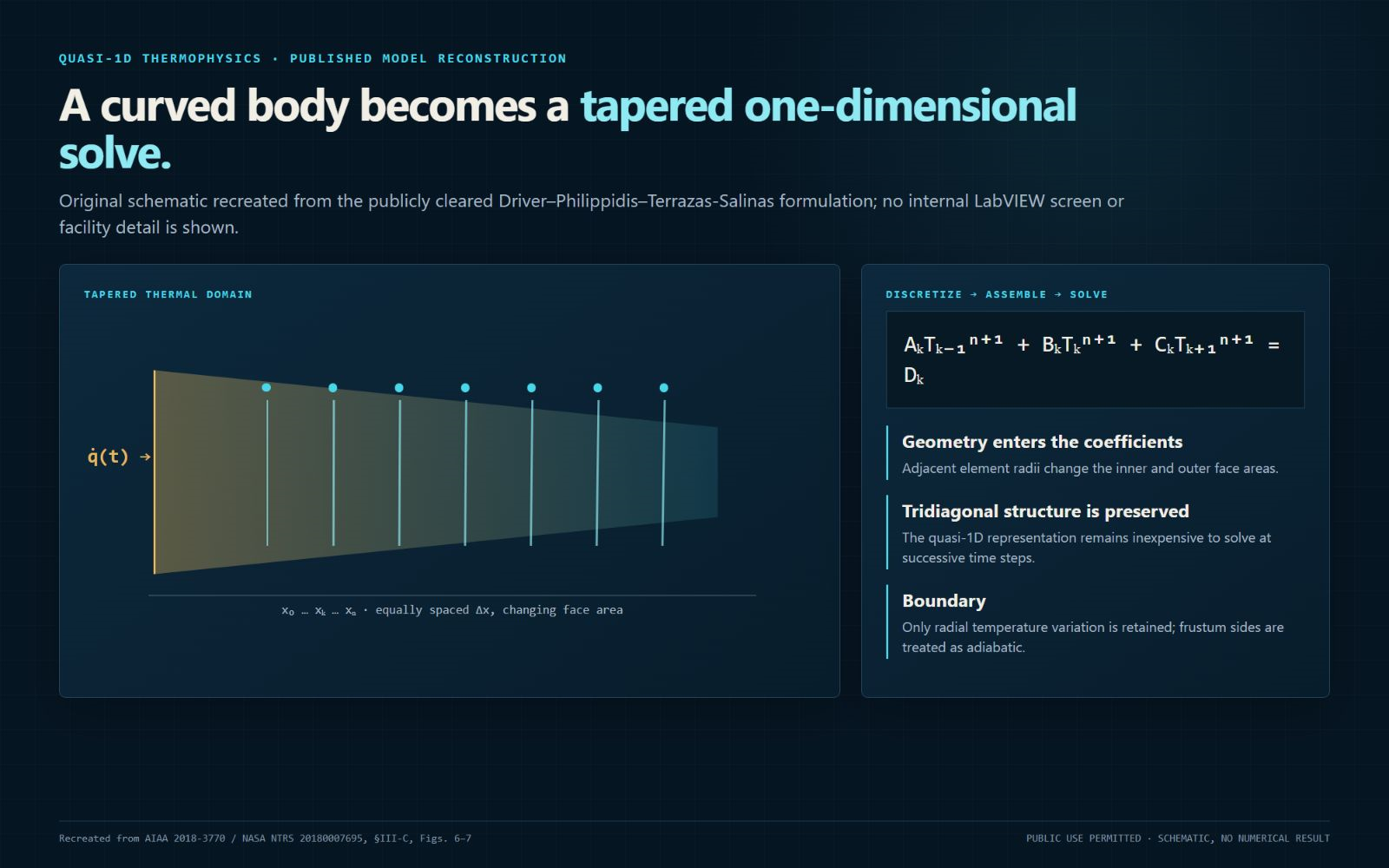
This modeling approach turns curved thermal hardware into a simpler one-dimensional problem that can be solved efficiently over time.
Open full-size view ↗Technologies & skills
Numerical and LabVIEW toolkit.
- applied thermophysics
- inverse heat conduction
- numerical methods
- finite-difference / finite-element modeling
- tridiagonal solvers
- LabVIEW
- scientific computing
- research-to-software translation
Project scope
Published thermophysics made operational in LabVIEW.
The project focused on understanding Driver, Philippidis and Terrazas-Salinas’s quasi-1D formulation in enough detail to express its geometry, coefficients, boundary conditions and tridiagonal solve in the existing calculation environment.
The result connected published mathematical research to the software used for arc-jet calorimeter analysis, preserving the method’s geometry-aware treatment in an operationally familiar form.
Inspect the evidence
Read the underlying NASA research and verify Brian’s role context.
Useful when
Your R&D team needs a published mathematical or scientific method translated into maintainable software inside an established workflow.
Explore scientific-software work →