Software Engineering Lead supporting NASA Ames through Amentum.
Systems integration / industrial data acquisition
PROFINET Data Path Engineering
PC Acquisition Host ↔ Siemens S7-1500
Industrial data-path integration spanning PCIe hardware, embedded C, PROFINET process-data mapping, GSD/GSDML configuration and Siemens PLC integration for a NASA Ames arc-jet acquisition system.
Bounded role account · Contract map · Public context
2 × 128separately managed FLOAT32 data regionsPCIeHMS/Ixxat INpact host interfacePROFINETPC acquisition host to Siemens PLCGSDMLdevice description aligned to firmware mapping
Application software, interface definitions and integration documentation spanning the host, device and PLC.
Established a working, documented path and delivered the application-specific software, interface definition and integration documentation.
A public-safe contract map, detailed project account and public CV role record.
01 / The difficult question
From vendor demonstration to acquisition-system interface.
A NASA Ames arc-jet data-acquisition upgrade required a PC-based acquisition system to exchange process data with a Siemens S7-1500 over PROFINET. The HMS/Ixxat INpact PCIe interface provided the underlying industrial-network connection, but its vendor examples were demonstration configurations rather than a drop-in representation of the acquisition system’s data model.
Integration also exposed mismatches between the device-side data definitions and the PLC configuration.
02 / Brian's contribution
Make every layer of the interface agree.
Brian worked through the interface from device setup and firmware configuration through application code, process-data mapping and Siemens PLC integration.
He defined a custom Application Data Instance layout built around two separately managed 128-element FLOAT32 blocks, with sequence counters for tracking updates. This replaced the vendor’s simple demonstration mapping with a structure suited to the acquisition application while allowing the two data regions to be managed independently.
He reworked the host application’s control loop into an explicit run/reset/quit state machine, added hardware selection through the command line and removed dependencies that complicated builds under the required Windows development toolchain.
He diagnosed PLC configuration problems by tracing the relationship between the compiled ADI definitions and the GSD/GSDML device description, then aligned the module and submodule definitions with the firmware’s actual process-data map.
He also built simulated-sensor and timing instrumentation so the software path could be exercised before full system integration, and produced technical documentation covering configuration, data mapping, application structure and PLC connection.
03 / How the system works
01Configure
Set up the device, firmware and selectable PCIe hardware path.
→02Define
Compile the application-specific ADI layout and sequence counters.
→03Align
Match GSD/GSDML modules and submodules to the firmware process-data map.
→04Exercise
Use simulated sensors and timing instrumentation before full integration.
Two separately managed FLOAT32 regions and sequence counters gave the acquisition application an explicit process-data contract across the host, firmware and PLC.
04 / Interface alignment
One data path, represented consistently at every layer.
The application’s ADI definitions, compiled firmware representation, GSD/GSDML device description and Siemens PLC configuration all had to describe the same modules, submodules and process-data regions.
An explicit run/reset/quit state machine and simulated inputs made application behavior easier to exercise and document while hardware and PLC integration were still in progress.
Process-data definition
Align both 128-element regions across the stack.
Sequence A128 × FLOAT32Sequence B128 × FLOAT32ADI ↔ firmware ↔ GSD/GSDML ↔ PLC
Application-specific data path
The work established a working and documented PROFINET path between the PC acquisition host and the Siemens PLC, with an application-specific process-data model replacing the vendor demonstration configuration.
Integration package
The application-specific software and interface definition were delivered with simulated-sensor support, timing instrumentation and technical documentation for incorporation into the acquisition system.
Public-safe implementation evidence
The mapping, made explicit.
A conceptual contract map shows the alignment problem without exposing restricted configuration or facility details.
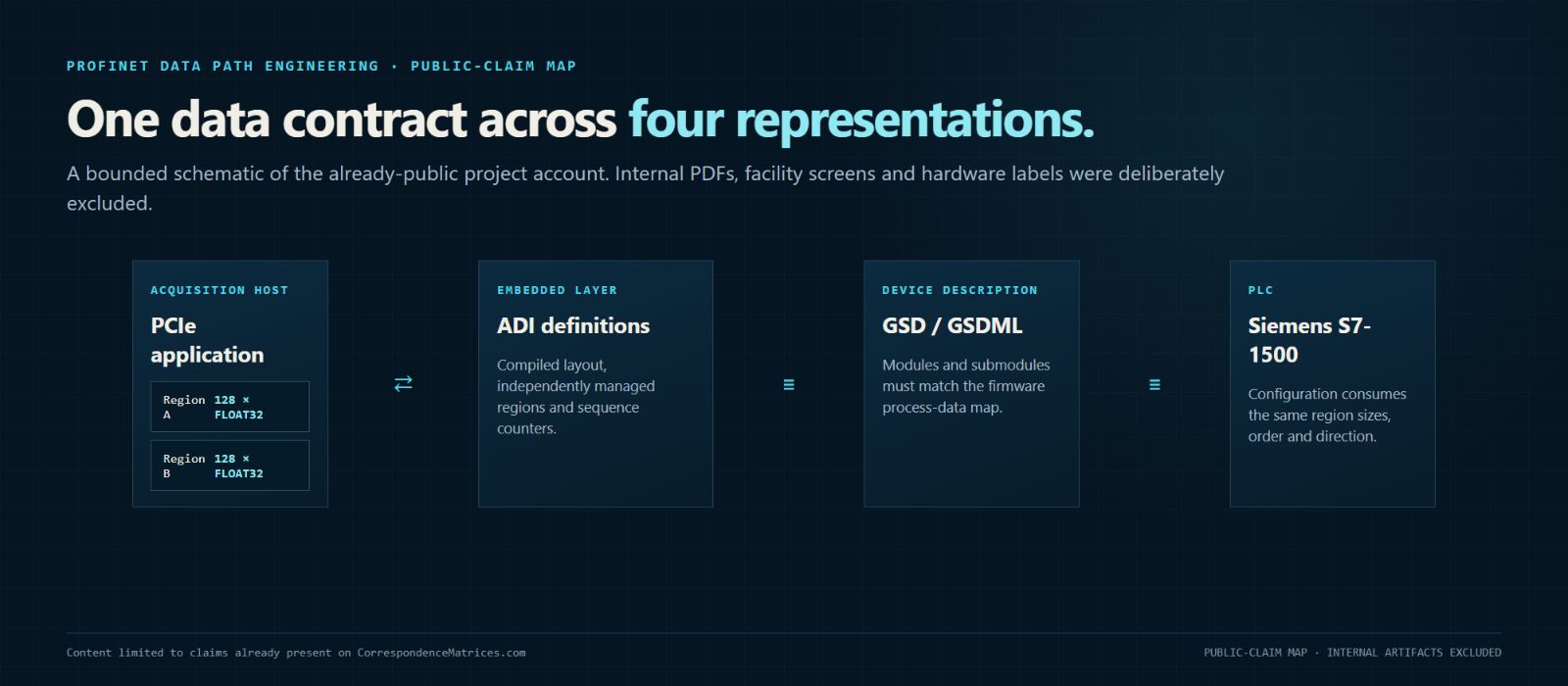
This project brings the host software, embedded mapping, device description and PLC configuration into one consistent data path.
Open full-size view ↗Technologies & skills
Interfaces and implementation tools.
- PROFINET
- Siemens S7-1500
- TIA Portal
- GSD/GSDML
- HMS/Ixxat INpact
- Anybus/ABCC
- embedded C
- PCIe integration
- industrial communications
- systems integration
Project scope
An application-specific interface ready for the next stage of integration.
The project focused on the complete software and configuration path: PCIe device setup, embedded application behavior, process-data mapping, GSD/GSDML alignment and Siemens PLC integration.
The working path, simulated-sensor support, timing instrumentation and technical documentation gave the wider integration team a concrete interface to carry into the acquisition system.
Inspect the evidence
Public role context without internal technical artifacts.
Useful when
Your team must align industrial devices, host software and control systems when configuration mismatches obscure the real data path.
Explore systems engagements →