Co-author and MATLAB/FSL processing-pipeline contributor within a team study.
Computational neuroscience & research methods
Resting-State Network Analysis
Anxiety dimensions. Network differences.
A research-method account for a co-authored resting-state fMRI study examining whether anxious apprehension and anxious arousal relate to distinguishable network structure and connectivity.
Peer-reviewed study · Published method · Role context
53adults in the published studyICAresting-state network identification2anxiety dimensions studied2025Journal of Affective Disorders Reports
Processing and analysis workflows using ICA, dual regression and FSLNets.
Anxious apprehension and anxious arousal showed distinguishable network-level associations.
A peer-reviewed 2025 article, aggregate findings figure and public CV role record.
01 / The difficult question
Do worry and anxious arousal relate to different resting-state network patterns?
The study took a transdiagnostic approach rather than treating anxiety as one undifferentiated construct. It examined anxious apprehension and anxious arousal while accounting for depressive symptoms.
The method needed to separate within-network structure from between-network connectivity and connect both to symptom dimensions without turning cross-sectional associations into causal claims.
02 / Brian's contribution
Build the analysis pipeline and contribute within a team study.
During his Palo Alto University role, Brian designed and built neuroimaging processing and analysis pipelines in MATLAB and FSL. He is a co-author of the 2025 paper with Stacie L. Warren, Whitney N. Geller and Kevin Liu.
This page describes the published team method and findings while keeping authorship precise. It does not assign sole ownership of the study, analyses or interpretation to any one co-author.
03 / How the system works
01Resting-state fMRI
Acquire and preprocess participant time series.
→02Independent components
Identify resting-state network components.
→03Dual regression
Test dimension-related within-network differences.
→04FSLNets
Estimate between-network connectivity differences.
The published analyses controlled for depression while testing anxious apprehension and anxious arousal as distinct dimensions.
04 / Network-level findings
The reported associations differed by anxiety dimension.
The paper reports that anxious apprehension was associated with expansion of default and somatomotor networks, increased default–salience connectivity and decreased dorsal-attention–limbic connectivity.
Anxious arousal was associated with hyperconnectivity within salience, limbic, frontoparietal and default networks. These are study-level associations, not diagnostic tests for individuals.
Published design
Two analysis scales for two anxiety dimensions.
Resting-state fMRI→ICA networks
vs arousal
Dual regression
within networkFSLNets
between networks
Apprehensionwithin networkFSLNets
between networks
vs arousal
A pipeline carried into publication
The processing and analysis workflow supported a published comparison of within-network and between-network patterns across two anxiety dimensions.
Different dimensions, different associations
Separating symptom dimensions can reveal network associations that may be obscured when anxiety is analyzed as one total construct.
Published-result reconstruction
Two symptom dimensions, different network patterns.
Each image is paired with the scope and context needed to interpret it. Open an image to inspect the full-size view.
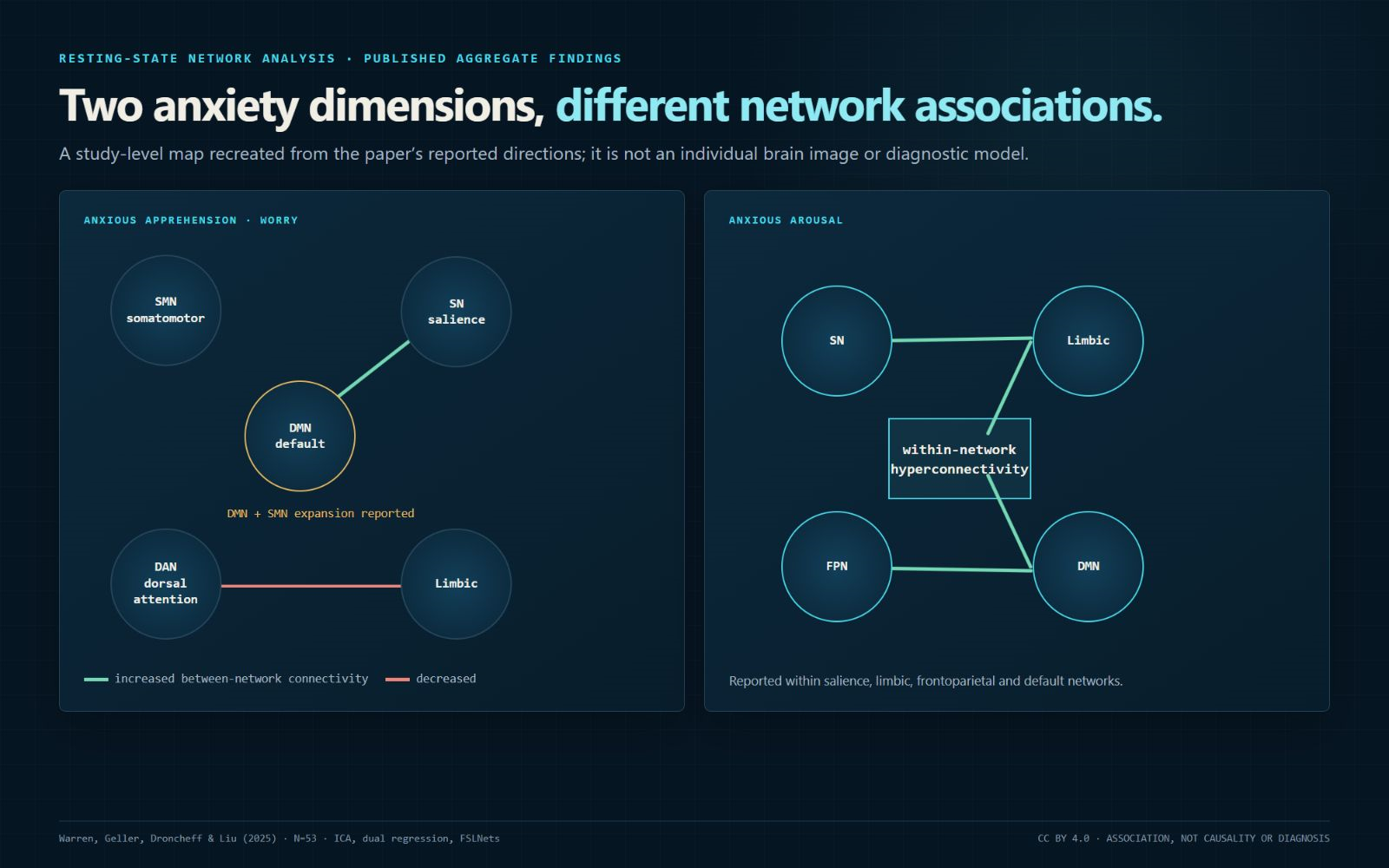
The study found that worry and anxious arousal were associated with different patterns of brain-network organization and connectivity.
Open full-size view ↗Scope & limitations
Cross-sectional associations in a modest sample.
The published sample included 53 adults. The paper states that larger samples and longer resting-state scans would improve confidence in reproducibility.
The cross-sectional design limits conclusions about temporal dynamics and causality. The reported group associations do not establish an individual diagnostic tool or an intervention effect.
Inspect the evidence
Read the peer-reviewed article and verify the attribution.
Useful when
Your research team needs a reproducible scientific pipeline, careful evaluation design and precise interpretation of statistical or model outputs.
Explore research-method validation →