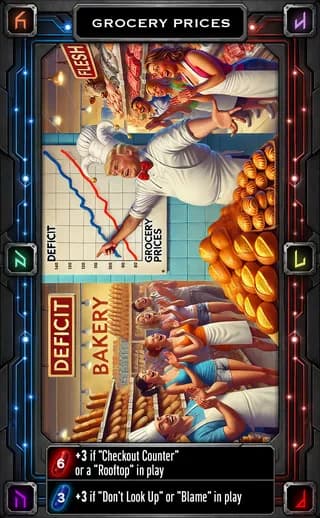


Creator, simulator author, digital-game implementer and production-system designer.
Simulation, rules & production tooling
Presidency or Prison
Build a system. Then disrupt it.
A live cooperative strategy game used as an R&D laboratory for rules, simulation and production. Its simulator, digital implementation and constrained visual language make balance and design decisions measurable instead of relying on intuition alone.
Live product · Simulator evidence · Published mechanics
1+players cooperate against the deck20–60published playtime range in minutesShareddeck and connected scoring structureScalabledifficulty and rule variants
A live game supported by simulation, constrained visual-language research and reviewable media workflows.
A game concept became an integrated rules, computational-design, validation and communication system.
Published mechanics, prototype cards, measured simulations and a live symbol application.
01 / The difficult question
How do you test strategy when connections change its value?
Presidency or Prison is built around a shared structure. Cards create points through their base values, edges and interactions, but later actions can bind, remove, revive or reconnect parts of that structure.
That makes balance more than a list of card values. The system needs rules that can be simulated, inspected and changed without losing sight of the player experience or the project’s satirical purpose.
02 / Brian's contribution
Treat the game, simulator and production pipeline as one R&D system.
Brian built a Python simulation engine using NumPy, pandas and NetworkX, with structured configuration and an operator CLI. He also developed a digital game implementation in Dart.
He also developed CCSGL as a constrained geometric language: candidate forms are enumerated, measured, optimized into a codebook and checked with deterministic and adversarial tests. For media, automated analysis can propose structure, cuts and scene specifications, while Brian’s feedback and editorial review determine what is accepted and produced.
03 / How the system works
01Encode rules
Represent cards, variants, effects and scoring.
→02Simulate play
Run state transitions over connected structures.
→03Inspect balance
Compare outcomes and failure patterns.
→04Validate & explain
Test visual separation and turn approved ideas into reviewable media.
The public game loop—draw, play, trigger effects, recalculate and resolve—provides the behavioral contract that the simulation and production tools support.
04 / Constrained visual language
Turn a symbolic idea into a measurable design problem.
CCSGL was developed by enumerating candidate geometric forms, extracting measurable features and optimizing a mutually separated codebook. The current draft records 249 congruence families, a provisional safe codebook of 24 forms, 23 assigned meanings and one reserve. Composite, blur and deletion tests expose collisions and assumptions that visual intuition alone can miss.
The computational results establish separation under the stated transformations and thresholds. They do not establish that people will recognize the forms reliably in real viewing conditions; the human-recognition package exists, but that validation remains incomplete.
Constraint pipeline
Select a codebook by measurement and falsification.
Enumerate→Features→Distance→Conflicts→Optimize→Validate
One product, several testable systems
The card-game concept became a live product with published rules, a personally implemented simulator and digital game, a falsifiable visual-language process and reviewable media workflows.
Different uncertainties need different tests
Simulation exposes rule interactions, constrained optimization exposes visual collisions and human editorial review keeps automated media analysis subordinate to the intended message.
Simulation evidence
A rule change with a measurable response.
Each image is paired with the scope and context needed to interpret it. Open an image to inspect the full-size view.
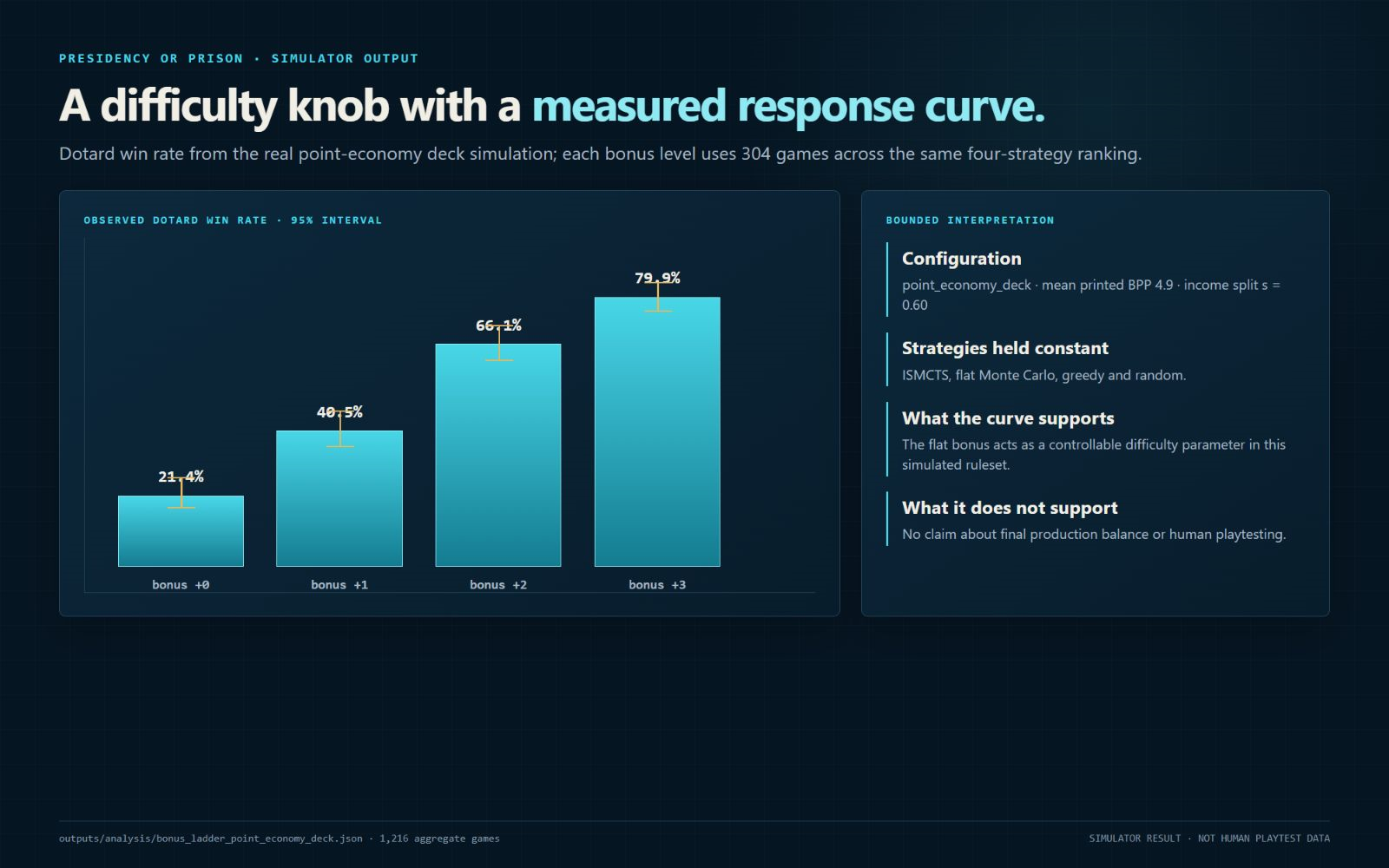
The simulator helps tune game difficulty by showing how a rule change alters outcomes across repeated computer-run games.
Open full-size view ↗Optional media evidence
Selected production examples.
Each video opens only when selected. The summaries provide an equivalent static account of what the example demonstrates.
Scope & limitations
A game system, not a predictive political model.
The product is in development and its cards, variants, balance and launch timing may change. Published playtime and player-count descriptions are current product framing, not independently validated market claims.
Simulation is used to investigate the designed rules. It does not predict elections, public behavior or institutional outcomes. The public site’s political and satirical framing belongs to the product, not to an employer or institutional partner.
CCSGL mappings and thresholds remain provisional. Computational separation tests are not a substitute for human-recognition studies, accessibility review or playtesting under real conditions.
Inspect the evidence
Read the public rules, project framing and live product surface.
Useful when
Your team needs to test products with complex rules, interacting state and uncertain user paths before committing to a larger build.
Explore simulation-led validation →