Author and independent research-programme lead.
Independent mathematics & research programme
B-Theory
A mathematical programme on self-reference.
A long-running independent research programme asking how a system might distinguish, represent and reflect on its own state using mathematical structures.
Authored programme · Working papers · Public research map
4linked mathematical research branchesStaticlogical states and distinguishabilityDynamiccontinuous change toward discrete truthOpenprogramme with working papers and project notes
A connected programme spanning logical representation, topology, homology and continuous change.
A speculative question was decomposed into mathematical objects that can be defined and criticized.
Authored programme notes, working papers and the Correspondence Matrices implementation lineage.
Start here
Three steps into the programme.
B-Theory is easiest to enter through one definition, one candidate mathematical object and one open question.
- DefinitionReflection compares a current state with a representation of that state.
- Worked objectWhen reflection preserves the state, the result can be studied as a candidate fixed point.
- Open questionWhich structures make self-versus-other distinctions stable, measurable and responsive to change?
01 / The difficult question
What lets a system recognize a change in itself?
B-Theory begins with distinguishability: a system must be able to represent differences before it can compare a prior state with a current one. The programme explores logical and geometric tools for making those comparisons explicit.
The public project divides the work into static representations, dynamic change and programmatic tools. Correspondence Matrices originated inside this programme before becoming a separate computational project.
02 / Brian's contribution
Develop a connected research map, not a single isolated formula.
Brian initiated and developed the programme. Algebraic Logic supplies Boolean modules, logical vectors and measurement language. Logical Topology treats truth assignments as points and propositions as sets, using distinguishability and distance as organizing ideas.
Logical Homology explores chains, cycles and the gluing of overlapping logical expressions. Evolutionary Logic investigates how continuous functions and thresholding might connect changing real-valued processes to discrete logical states.
03 / How the system works
01Represent
Encode expressions and logical states algebraically.
→02Distinguish
Organize truth assignments through topology and distance.
→03Relate
Study chains, overlaps, cycles and conceptual structure.
→04Evolve & reflect
Connect continuous change to discrete states and compare again.
The four branches are research directions that share a question; they are not claimed as a completed unified theory of mind.
04 / Reflection and fixed points
A self-model becomes testable only when reflection changes—or preserves—a state.
Logical Topology treats a state unchanged by reflection as a candidate fixed-point model of self-recognition. That idea gives the programme a concrete mathematical object to investigate instead of relying only on philosophical language.
The wider map asks how algebraic representation, geometric relation and continuous change could meet around that reflective operation.
Reflection model
Compare a state with its reflected representation.
State xrepresentationR(x)compareR(x) = x?
From philosophical question to research programme
The original question was decomposed into linked mathematical projects with public notes, papers and a computational offshoot in Correspondence Matrices.
Define objects that can be criticized
Each branch exposes a distinct object—state, distance, cycle, threshold or fixed point—so the larger question can be examined rather than merely asserted.
Author-owned programme evidence
The programme, in Brian’s own terms.
Two source-grounded plates connect the wider research architecture to the manuscript’s concrete argument about distinction, state comparison and feedback.
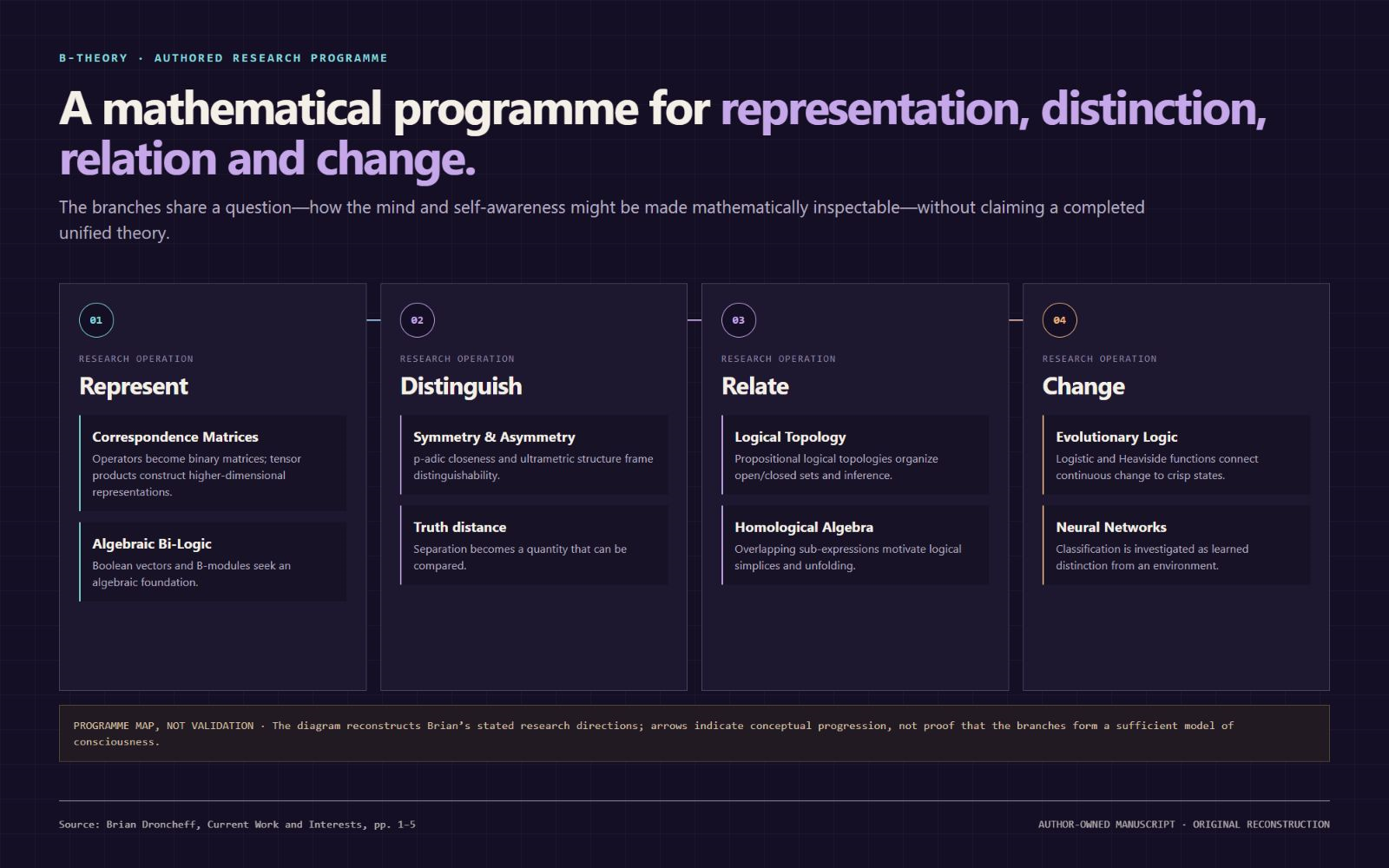
This map shows how Brian’s work on logic, structure, relation and change fits into one wider research programme.
Open full-size view ↗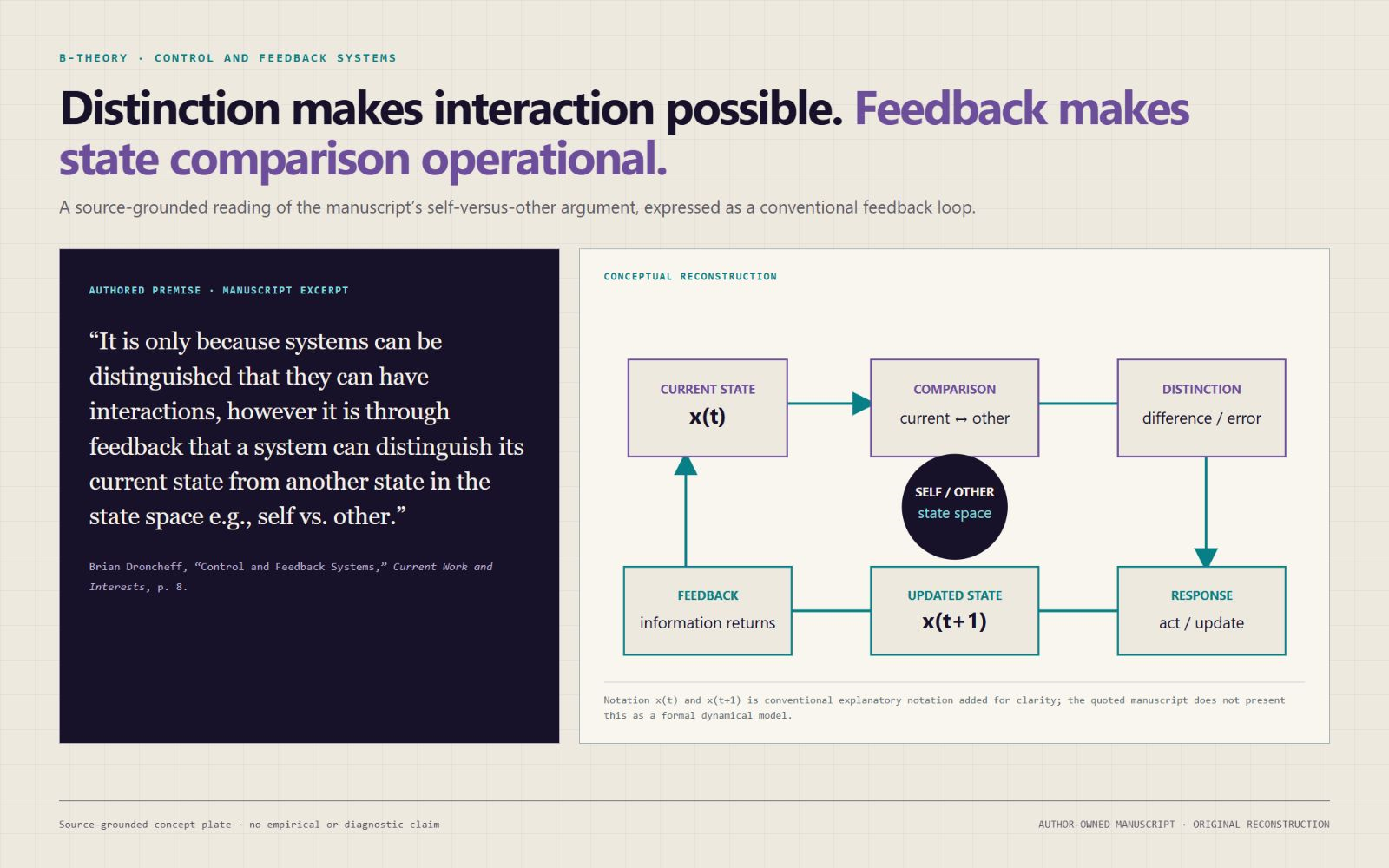
This visual shows feedback as a cycle of comparison: a system notices a difference, responds and updates its state.
Open full-size view ↗Scope & limitations
A research programme, not an established model of consciousness.
B-Theory is independent and exploratory. Its public pages and working papers should not be read as peer-reviewed validation of a mathematical theory of mind or as empirical neuroscience evidence.
The branch map describes research objectives and relationships. It does not establish that the proposed structures are sufficient for self-awareness, biological consciousness or machine consciousness.
Inspect the evidence
Follow the public programme and its research branches.
Useful when
Your organization is exploring an unconventional technical question that first needs to be decomposed into inspectable models and experiments.
Explore model-led investigation →