Product architect, implementer and reviewer.
Evidence-controlled research & publishing
Paper Workbench
Research claims with an audit trail.
A public, local-first workbench for research teams moving from source material to defensible claims. It keeps evidence, inference, human decisions and export integrity visible instead of turning provenance into an afterthought.
Public implementation · 101 offline tests · Evaluation reports
Project video · 6:13
Paper Workbench: evidence-controlled research
A walkthrough of claim-to-source provenance, human review, audit findings and reproducible research exports.
Click the picture to play. Full screen and volume are available in the controls.
Open the video file ↗101offline tests in the published record7deterministic audit finding codes evaluatedHumanapproval before consequential AI actionsPubliccode, evaluations and limitations
A local-first research workbench connecting sources, claims, human decisions, audits and export.
Claims remain connected to their source state, human decisions and export-time integrity findings.
Public code, capability matrix, 101 offline tests, audit scenarios and real application screens.
01 / The difficult question
How can AI assist research without blurring source, inference and claim?
Research tools often make drafting faster while making it harder to see where a statement came from, what evidence supports it and which decisions were made by a person. That is the wrong trade when the output must survive skeptical review.
Paper Workbench treats provenance and support state as part of the research object itself. Sources, excerpts, claims, dialogue turns, manuscript sections and exports remain linked, so uncertainty and verification debt can be inspected instead of being polished away.
02 / Brian's contribution
Make evidence control the architecture.
Brian conceived the product, defined its research and safety requirements, designed the architecture and built it through a closely supervised AI-assisted implementation workflow. No contractor contributed to the work. He retained responsibility for review, testing, capability boundaries and the decision records that shaped the implementation.
The system enforces typed support states and claim-to-evidence links, separates exploratory discovery from systematic-review claims, binds approved actions to plan hashes and records consequential mutations in the audit trail. Exports include checksums, access levels, findings and provenance rather than treating a formatted manuscript as proof of integrity.
03 / How the system works
01Ingest & preserve
Retain source files, excerpts, access state and extraction confidence.
→02Connect claims
Link each assertion to evidence, locators and an explicit support state.
→03Review actions
Keep AI suggestions provisional until a person approves the exact plan.
→04Audit & export
Surface integrity findings and carry provenance into the output bundle.
The workbench helps produce papers, but its durable product is a reviewable chain from source material to claim, decision and export.
04 / Provenance architecture
The research graph preserves disagreements, debt and decisions.
The canonical model connects research objects, sources, excerpts, claims, dialogue and manuscript structure. Controlled vocabularies preserve distinctions such as verified versus unresolved sources, supported versus provisional claims and empirical versus conjectured results.
Deterministic audits flag known integrity failures before export. AI-assisted dialogue is grounded in pinned context, and action proposals remain separate from human-approved execution. The system can therefore be useful even when a model is uncertain or wrong, because the surrounding workflow records what it relied on and what remains unresolved.
Claim ledger
Keep every assertion attached to its support state.
Claim C-17Provisional result statementstrength: computational
EvidenceSource S-04 · excerpt E-09locator + access state retained
ReviewAccepted with qualificationactor + decision recorded
Export auditNo unresolved citation findingmanifest + checksum
Inspectable implementation
The public repository documents a working end-to-end system with 101 offline tests, a capability-by-capability status matrix, portable project backup, research and manuscript workflows, and provenance-bearing Markdown, HTML, LaTeX, DOCX, JATS and PDF export paths.
Bounded evaluations
Selected workflows were verified against live language-model, search and scholarly-data providers. A small model-behavior regression suite also tested grounding, citation integrity, prompt-injection resistance, action safety and abstention. These checks establish integration and evaluation discipline, not general model correctness or production reliability.
Application evidence
Evidence stays attached.
The hero establishes claim-to-source provenance. This second non-sensitive capture shows implemented audit and export behavior without exposing private research.
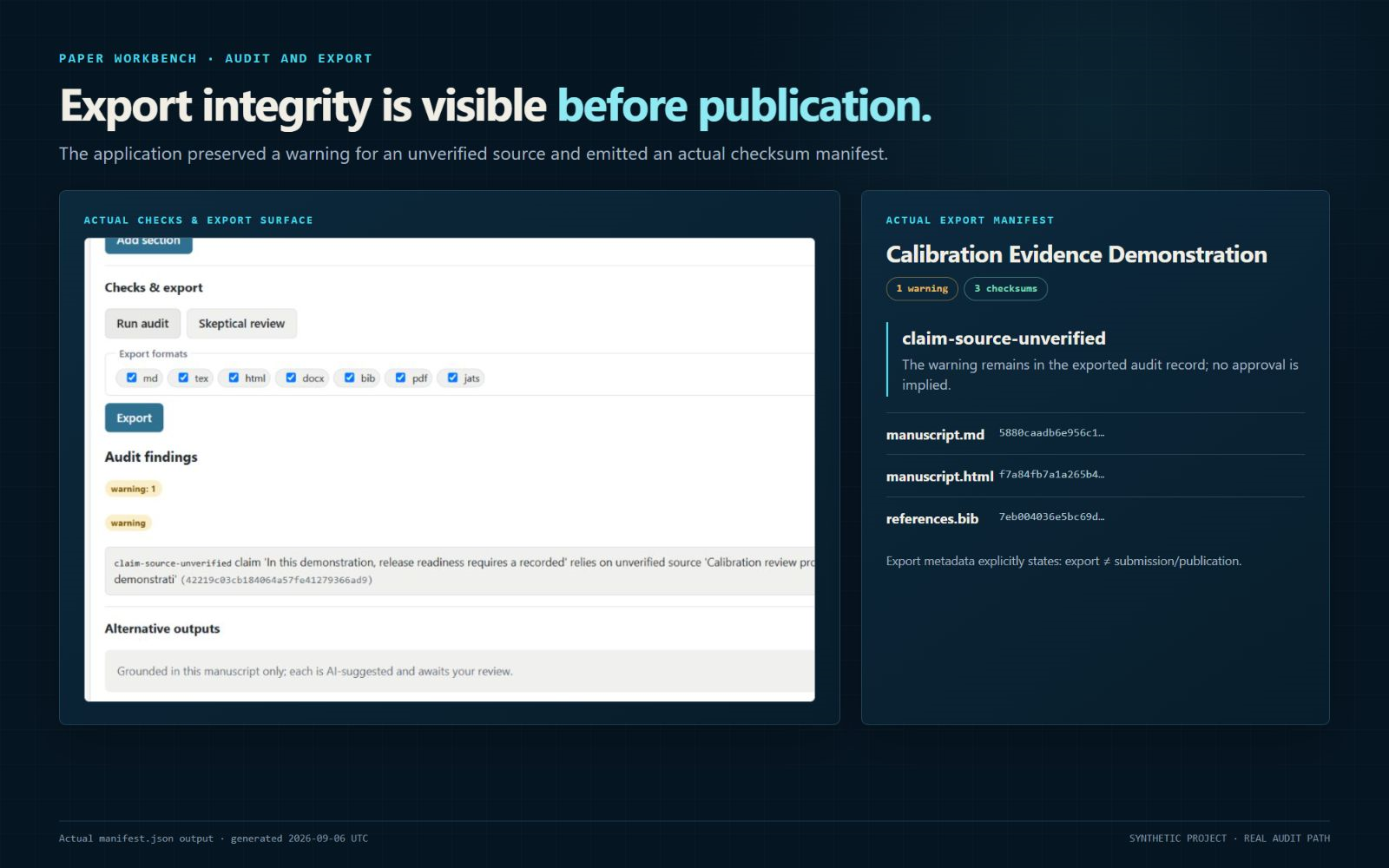
Before export, Paper Workbench surfaces unresolved checks and records file fingerprints so the final package can be audited.
Open full-size view ↗Scope & limitations
A research workbench—not an autonomous author or production publishing service.
The published evaluation is deliberately small. Its deterministic scenarios test seven known audit findings, and its live model-behavior suite is a regression signal rather than a correctness certificate. Provider verification does not establish broad production reliability.
The current trust model is local and single-machine rather than hardened multi-tenant infrastructure. OCR and layout-aware extraction, full systematic-review workflows, hardened identity-provider deployment and several collaboration features remain partial, planned or out of scope in the public capability matrix.
Inspect the evidence
Inspect the code, evaluated controls and documented boundaries.
01Paper Workbench public repositorySource and project documentation ↗02Capability matrixImplemented, partial and out-of-scope states ↗03Deterministic audit evaluationSeven finding-code scenarios ↗04Model-behavior evaluationBounded live-provider regression suite ↗05Documented limitationsKnown constraints in the public README ↗
Useful when
Your research or knowledge team needs AI-assisted work grounded in traceable sources, human review and reproducible evidence.
Explore evidence-system validation →