Framework architect and implementer within Brian’s NASA Ames software-engineering role.
Applied AI / engineering automation
Local Multi-Agent AI
Evidence-grounded engineering analysis.
A private engineering-analysis environment that finds evidence across technical documents, preserves source identity and coordinates specialized local-agent workflows without sending source material to cloud models.
Air-gapped system · Reproducible retrieval evidence · Public role context
Project video · 3:51
Local multi-agent engineering analysis
A walkthrough of evidence-grounded local-agent workflows, hybrid retrieval and source-aware engineering analysis.
Click the picture to play. Full screen and volume are available in the controls.
Open the video file ↗LocalOllama-hosted model executionHybridsemantic-vector and BM25 retrievalYAMLagent roles, tasks, goals and execution behaviorNLPdeterministic extraction alongside LLMs
A configurable local-agent environment combining private inference, hybrid retrieval and deterministic analysis.
Produced a local environment for technical search, extraction, relationship discovery and specialized engineering workflows.
A safe synthetic retrieval demonstration with public role and institutional context.
01 / The difficult question
Can local models support evidence-grounded engineering analysis?
Engineering work depended on large collections of requirements, component documentation, procedures and vendor material, while the information environment made unrestricted cloud-AI processing inappropriate.
The challenge was therefore not simply to add a chatbot, but to build an engineering-analysis system that could operate with locally hosted language models and retrieve evidence from technical source material.
02 / Brian's contribution
Combine configurable agents, retrieval and deterministic analysis.
Brian built a Python framework for specialized AI-agent teams whose roles, tasks, goals, workflows and model backends were configured through YAML rather than hard-coded into the application. Ollama provided local model execution, with timeout, retry and model-management logic suited to constrained hardware.
The retrieval layer combined persistent SentenceTransformers and FAISS indices with BM25 lexical ranking at sentence and paragraph granularity. This preserved both conceptual similarity and the exact identifiers and terminology common in engineering documents.
spaCy and NLTK supplied entity, phrase, dependency and relationship extraction alongside the language models. The resulting workflows supported question decomposition, component relationship discovery, specification parsing, evidence synthesis and structured risk analysis, backed by caching, incremental index updates, asynchronous processing and performance instrumentation.
03 / How the system works
01Configure
Define agent teams, roles, tasks, goals and model backends in YAML.
→02Retrieve
Combine FAISS semantic search with BM25 lexical ranking.
→03Extract
Use spaCy and NLTK to recover entities, phrases, dependencies and relationships.
→04Synthesize
Run engineering-specific analysis and structured agent workflows.
Local inference, evidence retrieval and conventional NLP remained distinct layers, allowing each part of the air-gapped system to be configured, inspected and improved independently.
04 / Local analysis architecture
Air-gapped operation was an architectural requirement.
Models, document indices and analysis workflows ran locally so engineering source material could remain inside the isolated environment. Cloud inference was not part of the operating path.
Configuration separated agent behavior, model selection and analysis tasks from application code, making the system adaptable as local models and engineering needs changed.
Layered local system
Give each analysis layer a specific job.
YAML agent teamsOllama modelsFAISS + BM25spaCy + NLTKPersistent indicesCaches + timeouts
Private analysis with traceable sources
The project produced a local environment for searching technical collections, extracting entities and relationships, organizing requirements and supporting specialized workflows without making cloud inference a prerequisite.
Cross-document engineering synthesis
Information about system components could be retrieved from separate sources and combined into a structured response while retaining the evidence needed for review.
Reproducible retrieval evidence
Find the evidence. Then check the report.
The hero shows traceable hybrid retrieval. This second plate follows a real synthetic multi-agent run through report generation and an independent source check.
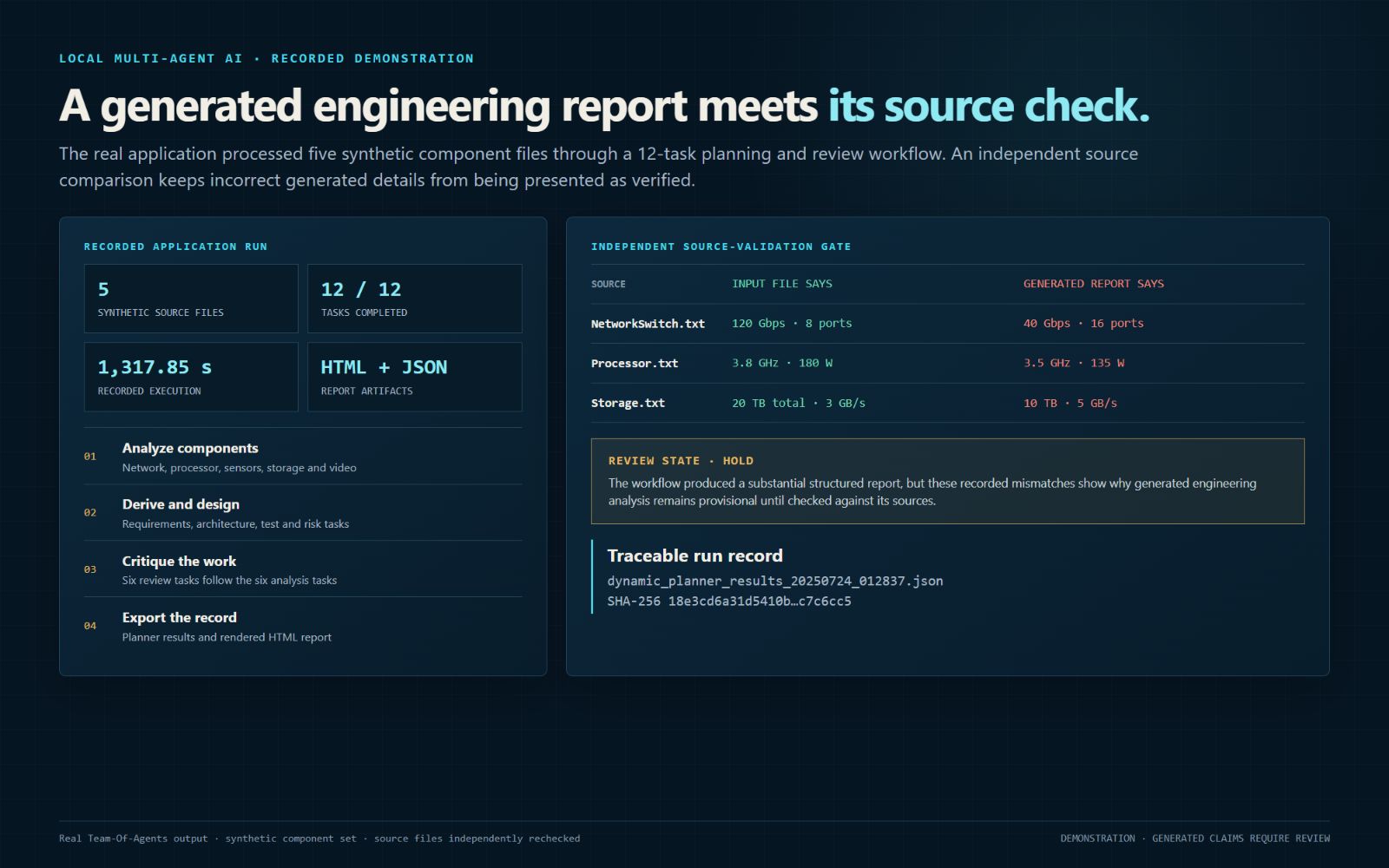
A real synthetic run produced a structured engineering report; an independent source check shows why generated details remain provisional until reviewed.
Open full-size view ↗Technologies & skills
Local models, retrieval and analysis.
- local LLMs
- multi-agent systems
- Ollama
- RAG
- FAISS
- SentenceTransformers
- BM25
- hybrid search
- spaCy
- NLTK
- NLP
- document intelligence
- systems engineering
- Python
Project scope
A local analysis environment built around engineering evidence.
The framework was built for an air-gapped engineering environment, combining locally hosted models with persistent retrieval, deterministic NLP and configurable agent workflows.
Its practical focus was technical search, extraction, relationship discovery, requirements organization and cross-document analysis on locally available source collections.
Inspect the evidence
Public role context without exposing source collections or internal artifacts.
Useful when
Your engineering team needs private document search and specialized AI workflows without sending source material to cloud models.
Explore private AI validation →