What the paper develops
The paper starts with the operator matrices, then develops rules for representing and combining larger logical expressions. It gives the formal definitions and derivations behind the visual examples above.
Correspondence Matrices / original research
Boolean relationships expressed as matrices.
I developed Correspondence Matrices as a structural representation of Boolean logic. A two-input operator becomes a binary 2 × 2 matrix, and larger expressions can be built and examined through that matrix structure.
Authored working paper · Worked examples · Public implementation
Want to see what happened when it was implemented? Explore the code and benchmark audit →
Watch the films: Film 1: CM Overview Video · Film 2: CM Benchmarking Video
Film 1 · 3:55
A walkthrough of the Correspondence Matrices representation, selected measurements, neural experiments and open research questions.
01 / The idea
Each binary Boolean operator has four possible input pairs. Placing its four outputs into a 2 × 2 matrix gives the operator a concrete shape. The atlas below shows all sixteen binary operators in that form.
For larger expressions, the representation aligns subexpressions against a shared set of truth assignments. The authored working paper develops the mathematical rules and notation; the implementation page shows how the idea fares in code.
The representation, made visible
Start with the sixteen two-input operators, then follow one expression into its matrix and an independent truth-table check.
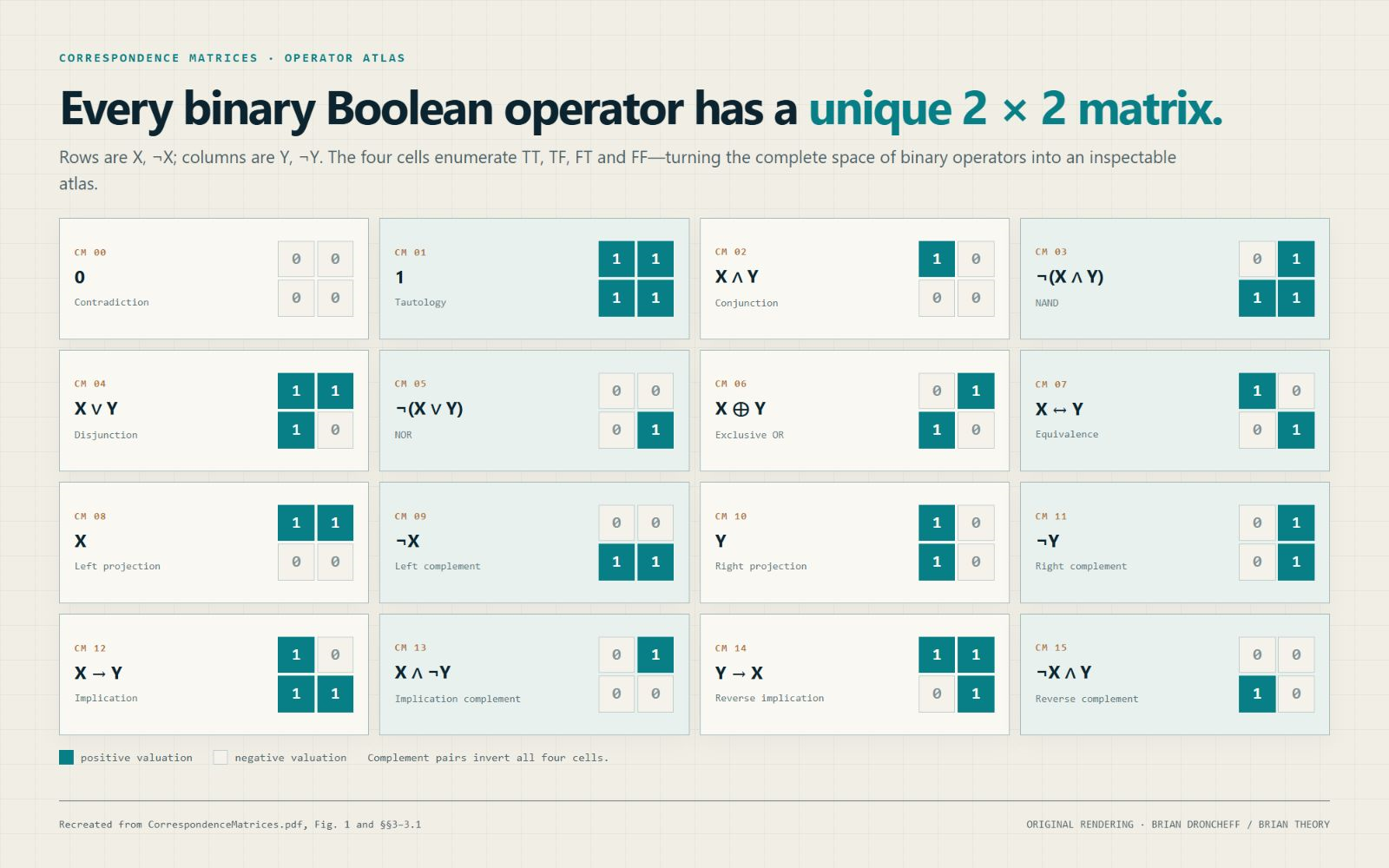
Each matrix cell records the output for one input pair. The sixteen cards cover every possible binary Boolean operator.
Open full-size view ↗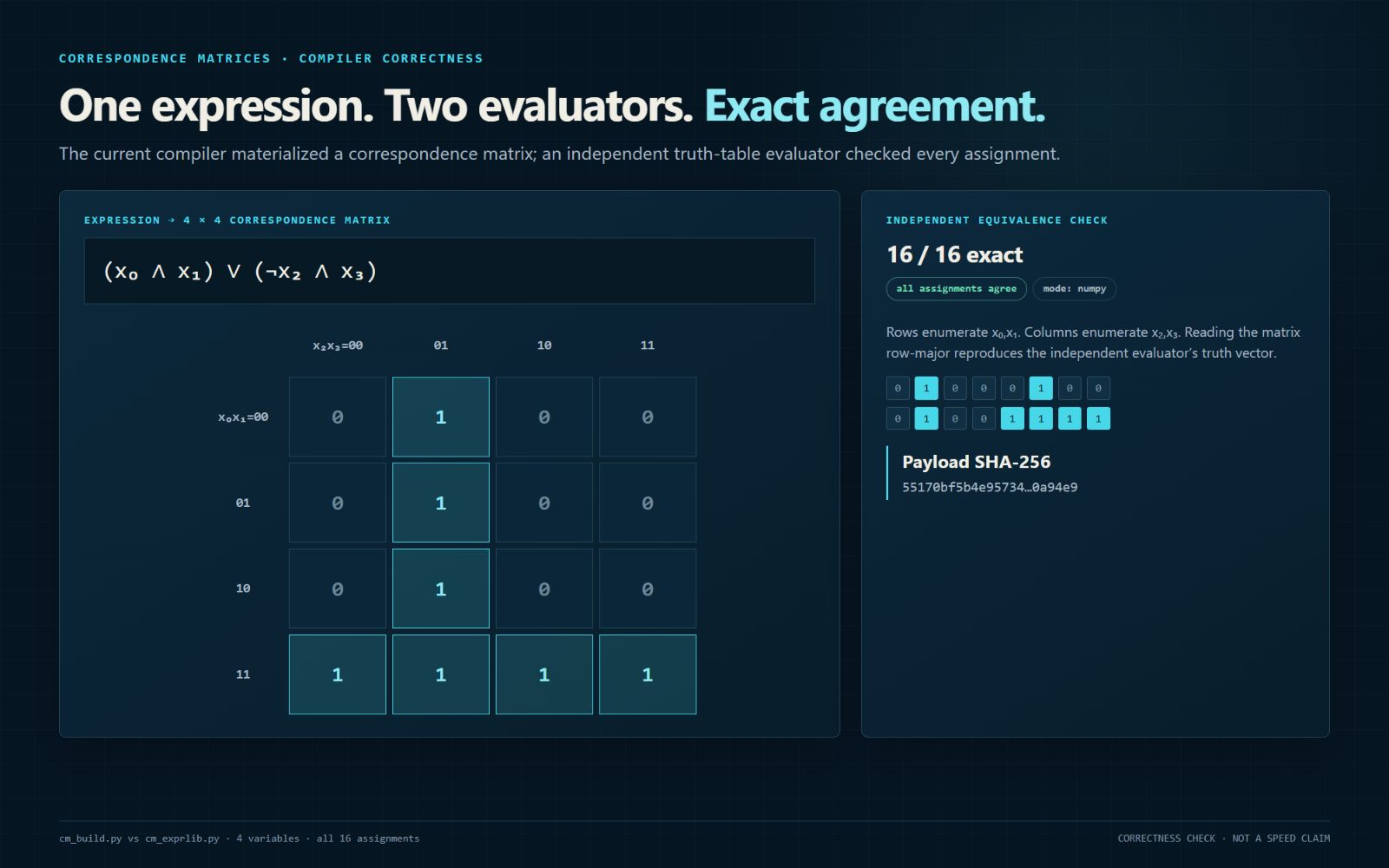
The compiled matrix and independent truth-table evaluation agree for this worked expression. This illustrates the implemented case; the paper supplies the broader formal account.
Open full-size view ↗The paper starts with the operator matrices, then develops rules for representing and combining larger logical expressions. It gives the formal definitions and derivations behind the visual examples above.
A mathematical representation does not by itself establish a faster complete computation or a commercial application. Those questions depend on implementation costs, required output, workload and comparison method. The companion case study records the current tests and their boundaries.
Follow the research