Product direction, workflow design, AI-assisted implementation and review of recorded behavior.
Assistant chatbots & local language models
Assistant & Digital Twin
Build an assistant. Ground it in your work. Run a model locally.
Independent R&D · Self-directed
The Assistant brings chatbot creation and source preparation into a signed-in workspace. Digital Twin extends that workflow with a small local language model and a trainable adapter, so a personal assistant can answer questions using professional documents while its model runs on the user’s own laptop.
Working local prototype · Narrated software walkthrough · Measured training and comparison
Project video · 3:50
Assistant & Digital Twin: from documents to local chat
The latest narrated walkthrough: source uploads, local LoRA training, base-model comparison, a grounded background answer and a separate B-Theory website draft. Compute waits are shortened.
Click the picture to play. Full screen and volume are available in the controls.
Open the video file ↗Read the narration transcript
This transcript follows the spoken narration. The figures and written evidence below provide additional visual context.
From The Assistant’s signed-in dashboard, open Digital Twin workspace. The following steps review the completed local training run. Use Professional documents to choose your source files. The completed run used Brian’s profile, AI software work, and engineering projects. The saved source documents are shown here.
New datasets default to an eighty percent training and twenty percent held-out target, with whole source documents kept together. Document sizes can make the actual ratio differ. Advanced settings under the uploads let you choose a different train-test split when needed. The earlier run keeps its original dataset and recorded split.
Prepare training examples builds a dataset from source paragraphs. This completed run contained twelve training examples and four held-out examples. The base model is Qwen three, zero point six billion parameters. This run trained a small LoRA adapter, with about one point one five million trainable parameters. It did not train the entire model from scratch.
Train Digital Twin starts the local training run after the dataset is prepared. The recorded run completed three optimizer updates. The video skips the compute wait. Training took eighty-three point eight seconds on an HP EliteBook eight forty-five G eight laptop, with an AMD Ryzen five PRO fifty-six fifty U
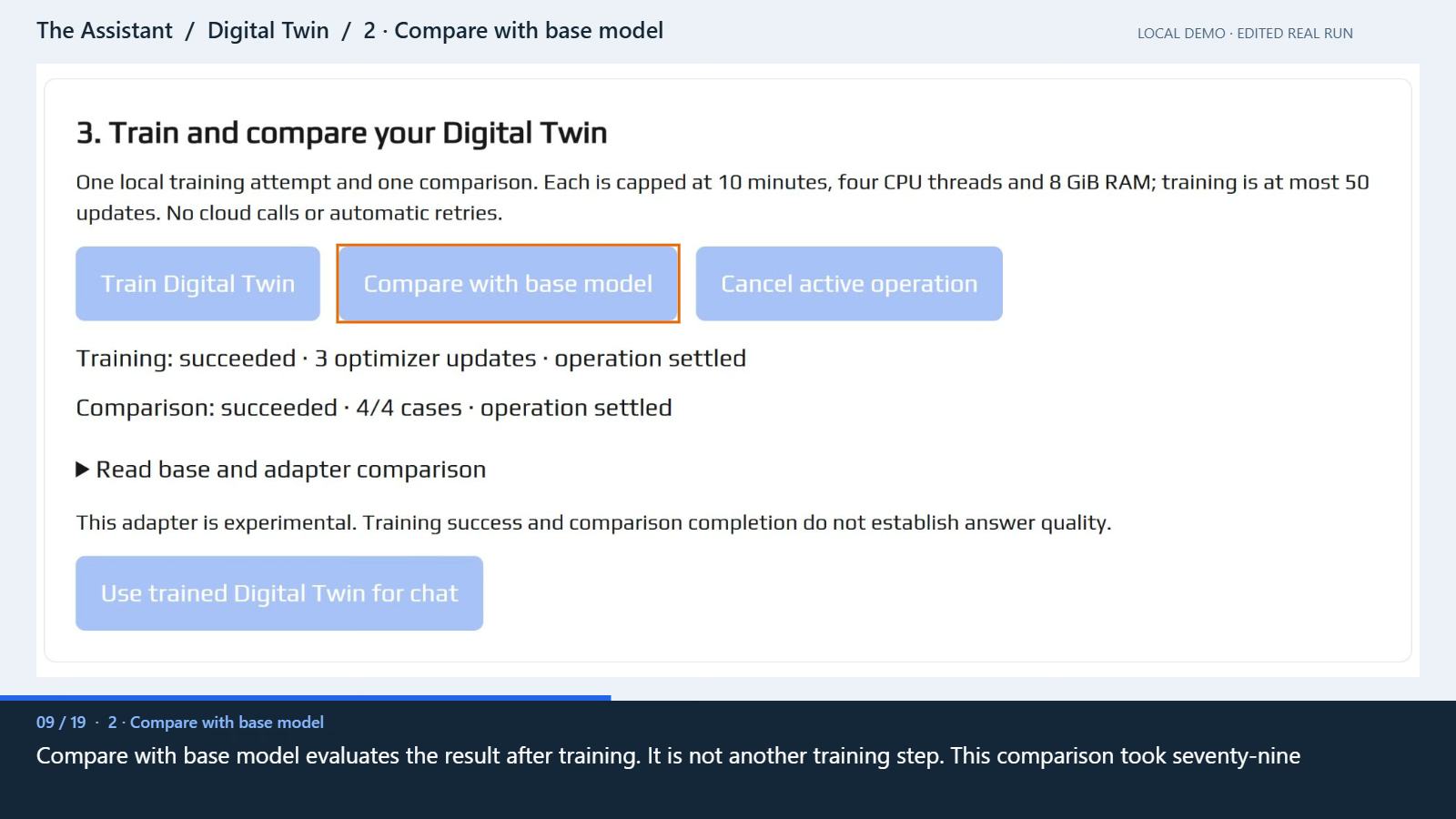
processor and thirty-two gigabytes of RAM. The run used four CPU threads, with an eight-gibibyte memory cap. Compare with base model evaluates the result after training. It is not another training step. This comparison took seventy-nine point five seconds. Both models scored zero out of four exact matches, so training success alone does
not establish answer quality. Cancel active operation stops a running training or comparison job. It is optional and is not required to finish training. The controls shown here are disabled because the recorded run has finished. Use trained Digital Twin for chat selects the new adapter. This completed
run already has that adapter selected. Enter the background question, then choose Ask your Digital Twin. The loading and generation wait is shortened in this edit. The answer describes Brian’s independent applied AI and research consulting, with engineering and computational neuroscience experience. The recorded reply took thirty-seven point seven seconds,
including model loading. Earlier imperfect replies remain in the history. The source excerpts let you inspect the evidence behind the answer. They come from the uploaded documents. For a website example, enter B-Theory’s address and choose Fetch website preview. The app records the public page, final URL, capture time, and source
hash. The example asks what B-Theory is about. Its proposed answer is an exact website excerpt. B-Theory is prepared separately; it has not been added to the selected adapter or trained. Download the website draft to save the source and example. Training this
example later needs a new dataset, held-out examples, and a separately approved compute budget. B-Theory develops mathematical ways to describe states, observations, and change. It examines how observations separate possible states and help update models. Connections to minds and self-awareness are exploratory research questions.
The workflow is upload, prepare, train, compare, select the trained adapter, and ask. Keep the measured results and supporting sources visible when judging what Digital Twin can do.
Download English captions (WebVTT)Qwen3-0.6Blocal base language model83.8 smeasured LoRA training run32 GBRAM in the demonstration laptop3:50narrated software walkthrough
A chatbot dashboard and local Digital Twin workflow connecting source documents, adapter training, comparison and chat.
A real local adapter run and an answer grounded in uploaded professional documents, with source excerpts available for inspection.
A narrated walkthrough, saved training measurements, comparison results and an explicit account of limitations.
Start here
Follow the dashboard into a local Digital Twin.
The showpiece film reviews a completed run, with spoken guidance and boxes highlighting the controls being described. Training and generation waits are shortened.
- Prepare the evidenceStart from The Assistant dashboard, upload professional documents and prepare training and held-out examples.
- Train, compare and selectRun local adapter training, compare it with the original model and select the trained adapter for chat.
- Ask and inspectAsk about Brian’s background, inspect the supporting excerpts and preview B-Theory as a separate website source.
01 / The difficult question
How can an assistant answer from personal knowledge on a laptop?
An assistant needs more than a chat box: it needs a way to bring in knowledge, keep the source visible and distinguish a plausible answer from a supported one. Personal and professional documents make that distinction especially important.
This project connects two related uses: creating assistant chatbots through a web workspace, and exploring small local offline models for a document-based Digital Twin. Here, Digital Twin means an assistant informed by selected records of a person’s work; it does not establish a replica of that person’s judgment or identity.
02 / Brian's contribution
Connect the product workflow to a real local model run.
Brian directed the assistant and Digital Twin product workflow, including the signed-in entry point, document preparation, training controls, comparison, model selection and source-visible answers. AI-assisted implementation connected the web interface to a bounded local Python model worker.
The demonstration records a real run and reports its hardware, timings and evaluation outcome. The walkthrough also explains the controls: comparison evaluates the model after training; cancellation stops an active operation; selecting the trained adapter determines which model is used for chat.
03 / How the system works
01Create & ingest
Open the chatbot workspace and upload documents. A public website can be captured as a source preview and draft.
→02Prepare & train
Create examples and a held-out split, then train a small LoRA adapter locally.
→03Compare & select
Run the base and adapter comparison, inspect the answers and choose a model for chat.
→04Ask & check
Generate an answer with uploaded-source excerpts and inspect the evidence behind it.
New datasets default to an 80/20 target with whole documents grouped together. The filmed historical run retains its original 12 training and 4 held-out examples. Website drafts remain separate until deliberately incorporated into a new dataset.
04 / Two connected capabilities
Assistant chatbots and a local Digital Twin.
The Assistant provides the chatbot workspace and source preparation. Digital Twin adds local Qwen3-0.6B inference and LoRA adaptation through Transformers and PEFT. The recorded run trained about 1.15 million adapter parameters; it did not train the complete model from scratch.
Once dependencies, model files and source material are present locally, training and inference can run on the laptop without a cloud model call. Website capture and initial downloads require a connection. The full hosted application is not represented as entirely offline.
The B-Theory example captures a public page with its final URL, capture time and source hash, then prepares an exact-excerpt answer as a downloadable draft. The film does not show that website example being trained into the selected adapter.
A measured run on ordinary laptop hardware.
Training completed in 83.8 seconds with three optimizer updates on an HP EliteBook 845 G8, AMD Ryzen 5 PRO 5650U and 32 GB RAM. The CPU worker used four threads with an 8 GiB memory cap. Comparison took another 79.5 seconds. These timings describe this small dataset and configuration.
A useful grounded answer, with limits visible.
The final recorded answer summarizes Brian’s consulting, engineering and computational neuroscience background using uploaded-source excerpts. Chat also uses a tailored overview prompt. Earlier attempts included factual errors, so the successful example is evidence of one useful answer rather than general reliability.
Technologies & skills
Implementation toolkit.
- Next.js & React
- Python model worker
- Qwen3-0.6B
- Transformers & PEFT
- LoRA adaptation
- Document grounding
- Public website source capture
- Evaluation & provenance
Scope & limitations
Training completed. Improvement remains unproven.
The comparison processed all four held-out cases, but both the base model and adapter scored 0/4 exact matches after capitalization and whitespace normalization. “4/4 cases” in the video means completed comparisons, not four correct answers.
Exact matching can reject valid paraphrases. However, earlier chat probes also made factual mistakes. A four-case wording test is too small and narrow to establish answer quality.
Evaluation asked questions without the source excerpts used in chat. The successful chat answer therefore does not isolate the benefit of fine-tuning. A fair quality assessment would compare factual correctness using identical questions and source context for both models.
This is an experimental local prototype, not a validated autonomous representative. Website ingestion shown in the film prepares a single public-page draft; it does not demonstrate a full-site crawl or a trained B-Theory bot. The film uses Brian HQ synthetic narration generated with ElevenLabs.
Inspect the evidence
Watch the workflow and inspect the measured result.
Useful when
You need to explore a document-based assistant, assess local model constraints or separate retrieval benefits from measurable fine-tuning gains before committing to a larger system.
Explore a focused technical investigation →